
 United StatesJFK
 MexicoMEX
 BrazilGRU
 ArgentinaEZE
 ChileSCL
 ColombiaBOG
 PeruLIM
 PanamaPTY
 Costa RicaSJO
 Dominican RepublicPUJ
 JamaicaMBJ
 BahamasNAS
 BarbadosBGI
 United KingdomLHR
 IrelandDUB
 FranceCDG
 GermanyFRA
 NetherlandsAMS
 BelgiumBRU
 SwitzerlandZRH
 AustriaVIE
 ItalyFCO
 SpainMAD
 PortugalLIS
 GreeceATH
 TurkeyIST
 DenmarkCPH
 SwedenARN
 NorwayOSL
 FinlandHEL
 PolandWAW
 Czech RepublicPRG
 HungaryBUD
 IcelandKEF
 United Arab EmiratesDXB
 QatarDOH
 Saudi ArabiaRUH
 IsraelTLV
 EgyptCAI
 MoroccoCMN
 South AfricaJNB
 KenyaNBO
 NigeriaLOS
 IndiaDEL
 PakistanLHE
 Sri LankaCMB
 SingaporeSIN
 MalaysiaKUL
 ThailandBKK
 VietnamSGN
 PhilippinesMNL
 IndonesiaCGK
 Hong KongHKG
 ChinaPVG
 TaiwanTPE
 JapanHND
 South KoreaICN
 AustraliaSYD
 New ZealandAKL
Madrid-Barajas is a big, busy hub with four terminal areas, and it has a fixed-fare taxi system that works well for most visitors. That makes this page a comparison as much as a pitch: for a short, simple ride into Madrid, the official taxi or the Metro may be exactly what you need. A pre-booked Madrid airport transfer earns its place when you have bags, children, a group, an early meeting, or a client to impress. Below are the facts, the terminals, the real alternatives and how a chauffeur pickup works.
Should you book a private Madrid airport transfer or take a taxi?
For one or two people going inside the M-30 ring road, the official fixed-fare taxi is simple and fair. Book a Madrid airport transfer when you want a driver waiting at arrivals, a larger vehicle, a confirmed fare for an address outside the zone, or flight tracking. The booker shows the fixed fare before you pay.
Enroutz.ca is a Toronto-based chauffeur service. Our own fleet and chauffeurs run in Toronto, the GTA and Ontario. In Spain the ride is delivered by a vetted, licensed and commercially insured local chauffeur partner, and the Enroutz.ca desk books, confirms and invoices it. One booking, one confirmation, one invoice, and a 24/7 desk.
Enter Madrid airport and your hotel in the booker, and the exact all-in fare for the vehicle and route appears before you pay.
Madrid-Barajas terminals: T1, T2, T3 and T4
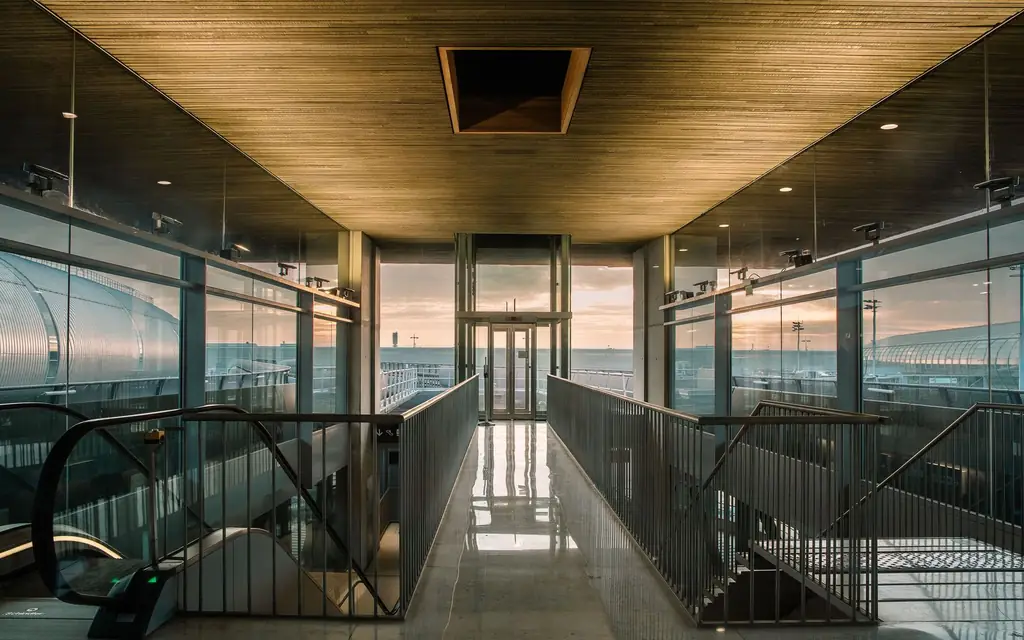
The airport's official name is Adolfo Suárez Madrid-Barajas, and its operator, Aena, lists five terminal areas: T1, T2, T3, T4 and the T4 Satellite (T4S). T1, T2 and T3 share a Metro station named "T1-T2-T3 Airport", located in Terminal 2 on floor 1, while T4 has its own station and railway stop. According to Aena, T4 is served by Metro Line 8 and the suburban train lines, and the T4 Satellite is part of the T4 area.
Why this matters for a pickup:
- Different pickup areas. The chauffeur's meeting point depends on which terminal your flight uses. The desk follows live flight data and gives you the arrangement before you land.
- Different transport options. Metro Line 8 and the suburban train serve T4 at floor -1, while the Metro stop for the other terminals is at T2.
- Check the boarding pass. Airlines move between terminals, and a forum post from last year is no guide.
See Aena's page for getting to Madrid-Barajas for current terminal links.
Madrid Airport to the city: distance, time and options
Barajas is about 15 km north-east of central Madrid. By road the drive typically takes 20 to 40 minutes, longer in the morning and evening peaks. Because the airport is connected to the city by motorway and by rail, public transport is quick for the centre.
Aena provides these details for the main options (as of 2026):
- Metro Line 8. Runs from Nuevos Ministerios to the airport, with stations at "T1-T2-T3 Airport" and "T4 Airport". Service runs from 06:05 to 02:00 every day, and passengers pay an airport supplement of €3 on top of the zone A fare to enter or leave at either airport station.
- Suburban train (Cercanías) line C-1. Serves Príncipe Pío, Atocha, Chamartín and Airport T4. Fares quoted by Aena start at €1.70 one way for zones 1 and 2.
- Airport Express bus, line 203. Runs 24 hours from Atocha railway station, with stops at T1, T2 and T4, and a flat fare of €5.
- Official taxi. Taxi ranks are on floor 0 at T1, T2 and T4. A fixed fare of €33 applies 24 hours a day for journeys starting or ending at the airport and inside the M-30 ring road; the rate allows no supplements.
| Option | Typical time to central Madrid | Cost note | Best for |
|---|---|---|---|
| Metro Line 8 | Varies by destination | Lowest, plus airport supplement | Solo travellers near Nuevos Ministerios |
| Cercanías C-1 | Varies by destination | Lowest | Atocha, Chamartín and Príncipe Pío |
| Airport Express bus 203 | Varies with traffic | Low, flat fare | Atocha and the centre, 24 hours |
| Official taxi | About 20 to 40 minutes | Fixed fare inside the M-30 | Short notice, no booking |
| Rideshare (VTC) | About 20 to 40 minutes | Variable | Small groups with an app |
| Hotel shuttle | Varies | Included or fixed by the hotel | Airport-area hotels |
| Rental car | About 20 to 40 minutes | Per day plus parking | Day trips beyond Madrid |
| Private chauffeur | About 20 to 40 minutes | Fixed fare via booker | Groups, luggage, address outside the M-30, flight tracking |
Our view: the official fixed-fare taxi is a good deal for a simple trip inside the M-30. Book a chauffeur when the address lies outside the ring, when you need a larger vehicle or child seats, when your arrival is late, or when you want someone holding your name at arrivals.
Details on each option are on Aena's pages for the Metro, the taxi and the bus. Prices change, so use the live figures on the day.
How VTC and chauffeur pickups work at Barajas
In Spain, "VTC" (vehículos de turismo con conductor) is the category for pre-booked private hire vehicles. Aena lists the VTC meeting points as car parks P1 (west zone), P2 (module C, floor 1) and P4 (module B, floor 4), and lists vehicles with driver at T4 at the P4 car park, module D, floor 4. For rideshare apps, Aena describes requesting the ride after arrival and then going to the exclusive parking area in your terminal to meet the driver.

What this means for you:
- A chauffeur is usually met in a defined place. The desk shares the meeting arrangement before landing, and a name-board meet and greet inside arrivals is available as an add-on.
- Luggage. The walk from arrivals to a car park is longer than a taxi rank, so a driver who helps with bags matters.
- Rules change. Pickup zones are set by the airport and updated from time to time. The desk confirms current arrangements in your booking.
Aena's VTC page lists the current points.
Flying from Toronto to Madrid: planning the arrival
For travellers flying from Toronto to Madrid the flight is usually overnight and lands in the morning, six hours ahead of Toronto time for most of the year (five for a short stretch each spring and autumn). Madrid is a late-evening city, so a morning arrival and a long first day work well with a driver who knows the streets.

The Government of Canada notes that Canadians do not need a visa for stays up to 90 days in any 180-day period in the Schengen area, and that the passport must be valid for at least three months after departure. It also says ETIAS applications were not yet open and that the Entry/Exit System records a facial image and fingerprints on entry, with no action needed before travel. The same page warns that pickpocketing is common in Madrid and Barcelona, especially at transit hubs, airports and crowded places, and advises caution towards anyone posing as plain-clothes police. A pre-booked car with a named driver reduces the number of strangers you deal with in the first hour. Read travel.gc.ca for Spain before you fly.
Day trips from Madrid: Toledo, Segovia and the Sierra
Many visitors use the airport transfer as the start of a longer drive. Toledo, the walled former capital, and Segovia, with its Roman aqueduct, are each roughly an hour to an hour and a half by road from central Madrid; both figures are approximate and depend on traffic and the day of the week. A chauffeur booked by the hour or as a one-way transfer from Barajas lets you skip the rental-car desk, the toll-road questions and the parking search in a historic centre.
If you are combining a Madrid arrival with a stop elsewhere, say so when you book. The desk can quote a single multi-stop journey rather than two separate transfers. See private tours with driver and city-to-city car service for how those bookings work.
Vehicle classes for Madrid transfers
Vehicle names are "or similar" and the exact model is confirmed at booking.
- Executive Sedan (Mercedes-Benz E-Class, Cadillac CT6 or Lyriq or similar): up to 3 passengers, 2 large and 2 cabin bags.
- First Class Sedan (Mercedes-Benz S-Class, BMW 7 Series or similar): up to 3 passengers, 2 large and 2 cabin bags.
- Luxury SUV (Cadillac Escalade, Chevrolet Suburban, GMC Yukon Denali or similar): up to 6 passengers, 5 to 6 large bags.
- Executive Sprinter (Mercedes-Benz Sprinter): up to 12 passengers, 12 bags.
- Mini-coach and coach, 20 to 56 seats, on request.
- Maybach, Rolls-Royce, stretch limousine and armoured vehicles, on request, with availability confirmed at booking.
Partner vehicles are no more than 4 model years old; Rolls-Royce, Bentley and Maybach up to 7. Wi-Fi, water and phone chargers are in most vehicles. Child, toddler and booster seats are available on request at booking. The fleet page shows the range.
Flight tracking, meet and greet and waiting time
Every airport pickup includes flight tracking. Waiting is free for 60 minutes after landing on international arrivals, 30 minutes on domestic arrivals and 15 minutes on other pickups. The free waiting time absorbs a slow passport hall.
A name-board meet and greet is available as an add-on. The board can carry an alias instead of your name. Chauffeurs do not photograph clients or post about trips, and NDAs are signed on request. See meet and greet service and VIP chauffeur.
Madrid business travel, conferences and groups
Madrid is Spain's corporate capital and a major conference city. Business arrivals usually involve several people landing on different flights, a tight morning, and a receipt that matches an expense policy.
- Several flights, one booking. Each passenger's flight can be tracked, and arrivals combined into one vehicle when timing allows.
- Corporate accounts. Monthly invoicing is available. See corporate accounts and corporate chauffeur service.
- Groups and delegations. The Executive Sprinter, mini-coach and coach classes are available via group transportation. For multi-day programmes see meetings, incentives and conferences.
- Day hire. For a day of appointments, the hourly chauffeur service keeps one car with you.
Enroutz.ca is a chauffeur service, not a security company. We have no armed drivers or bodyguards, and we work alongside your own security team where you have one.
Leaving Madrid: departure timing
For a departure, the chauffeur collects you at the hotel at an agreed time and drives to the right terminal. Check your boarding pass for T1, T2, T3 or T4 before you tell the desk. Because Barajas has large terminals and international security queues, leave a comfortable margin. If your next stop is Toronto, book the return leg from Pearson at the same time through Pearson airport limo or Toronto airport transfer.
For onward travel in Spain, see our Barcelona airport page and the Madrid chauffeur service page, and browse the Europe hub and the airports directory.
Frequently asked questions
How far is Madrid Airport from the city centre?
About 15 km. The drive typically takes 20 to 40 minutes depending on traffic, and rail and Metro links serve the centre.
Is there a fixed taxi fare from Madrid Airport?
Yes. Aena lists a fixed fare of €33 for trips between the airport and any point inside the M-30 ring road, valid 24 hours a day with no supplements. Check Aena for the current amount.
Which terminal will my flight use?
Madrid-Barajas has T1, T2, T3, T4 and T4 Satellite. Your boarding pass or airline confirmation shows the terminal, and the desk confirms the meeting arrangement before you land.
Is the Metro or a chauffeur better from Madrid Airport?
The Metro is quicker and lower cost for a hotel near a station and a light bag. A chauffeur is better with luggage, children, a group, or an address far from a station. The booker shows a fixed fare for the chauffeur.
Where does my chauffeur meet me at Barajas?
The desk confirms the meeting arrangement in advance. Aena lists defined VTC meeting points in car parks P1, P2 and P4, and a name-board meet and greet inside arrivals is available as an add-on.
How much does a Madrid airport transfer cost?
The fare depends on addresses, vehicle class and timing. The online booker shows the exact all-in fare before you confirm.
What if my flight is delayed?
Flight tracking is included. On international arrivals the first 60 minutes after landing are free waiting time, and the chauffeur adjusts automatically.
Do Canadians need a visa for Spain?
No visa is needed for stays of up to 90 days in any 180-day period in the Schengen area, and the passport must be valid for at least three months after departure. Check travel.gc.ca for ETIAS and the Entry/Exit System.